
The Problem: A new executive order had prompted our federal clients to embrace a more user centered digital first mentality and they were looking for contractors that had expertise in these fields. While we had a wide array of talents, my company lacked consistent digital capability across its workforce.
The Strategy: I designed and co-lead an internally funded workforce development pilot program, built around key skill gaps, validated with SMEs, and structured so participants applied learning directly to live project work.
Results: 72 participants trained, 116 certifications earned, 95% applied skills on active projects, 77% reported increased commitment to staying at the company.
Overview
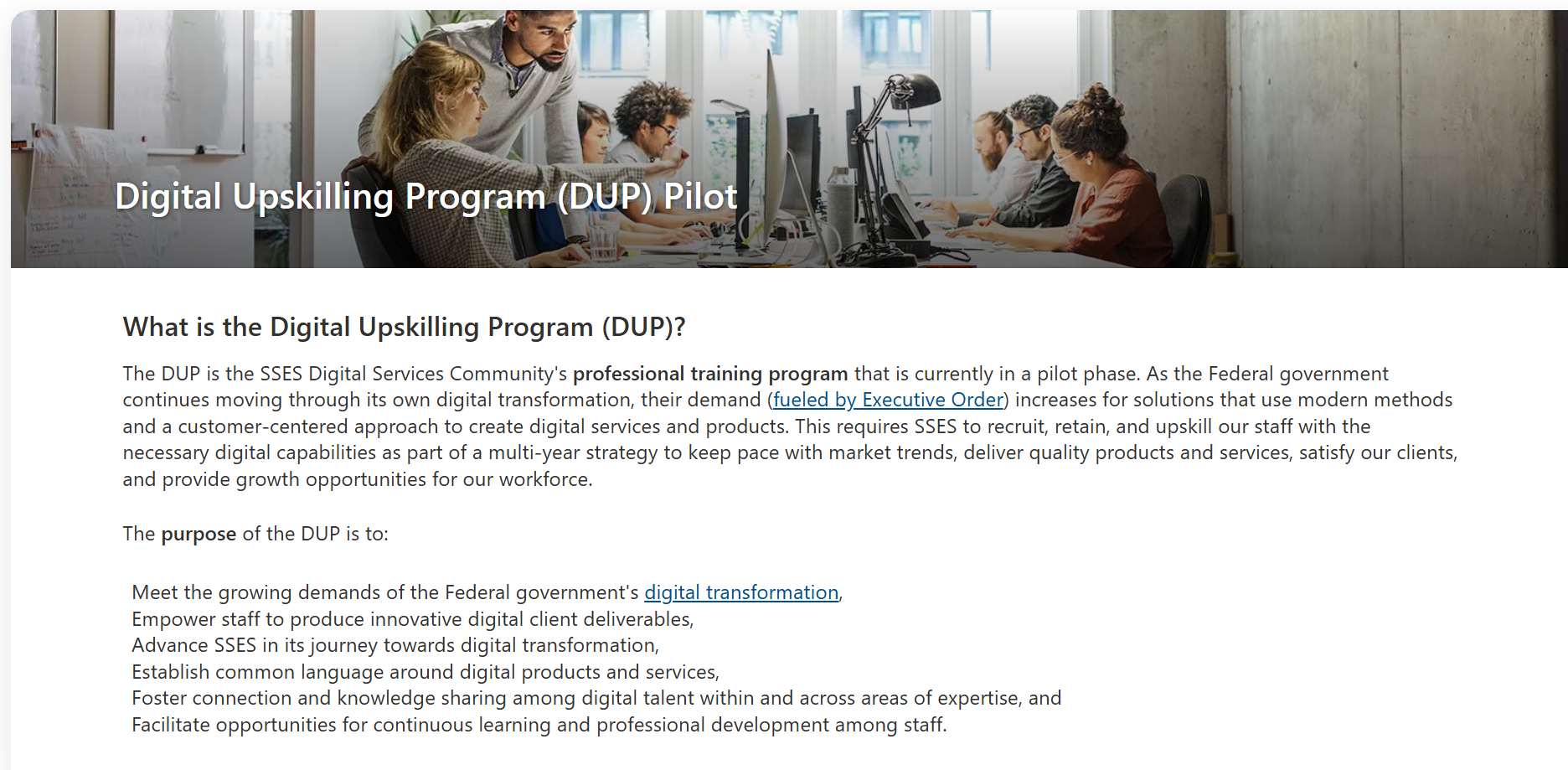
The Digital Upskilling Program (DUP) was an internally funded pilot at RTI International designed to build capability in digital product delivery starting with UX, product ownership, and digital strategy, to meet the growing demand of our federal clients for human centered, digital first products.
I co-led the program from conception through evaluation over a five-month pilot in FY22, alongside a cross-functional team including HR, finance, and subject matter experts from across the organization.
Role: Co-Lead — Strategy, Program Design, Curriculum, and Operations
Metrics: 72 participants · 116 certifications · ~2,200 training hours
The Challenge
RTI was facing growing demands from our federal client for user-centered digital services, but key skill levels in product management, UX, digital strategy, and others varied across teams. This made it difficult to compete on grants, staff projects, or deliver consistently.
An additional constraint: previous training programs at RTI had failed due to cost barriers, time pressure, and misalignment with how HR and finance actually work. This led to additional awareness and pressure from leadership to ensure the program was managed properly and efficiently.
My Approach & Actions
Discovery — to scope the work, my team conducted 14 interviews with SMEs and senior leadership to identify the highest-need skill, then conducted an environmental scan of 40+ existing training programs to identify the best options. This helped us ensure the program aligned with leadership’s goals and the client’s needs.
Program Design — We structured the program around eight specialization areas across three tracks: Product, Strategy, and UX. I co-developed an internal curriculum that covered the basics of product ownership, human-centered design, digital strategy, and digital content creation. We also built in structured evaluation including monthly progress reports, 1:1 interviews, and a group retrospective, to be able to evaluate on the pilot for future iterations.
Funding Model — I modeled program costs and scaling scenarios, estimated participant time investment (~30 hours per participant), and projected expansion costs. We built a hybrid funding model combining strategic investment funds with RTI’s existing Develop & Grow reimbursement program, which allowed the program to run within the current budgetary approvals, avoided interdepartmental conflict, and allowed the program to scale if the pilot data supported it.
Execution — Recruitment, onboarding, enrollment tracking, and monthly check-ins across 72 participants over five months. I also acted as a resource and mentor to participants through the process.
Outcomes
Of the 56 participants who responded to the post-program survey, 95% had already applied what they learned to active project work and reported an improvement in the quality of their work. The program earned an NPS of 69.4 which was higher than most internal initiative I had been a part of. Perhaps most telling for leadership: 77% reported feeling more or much more confident that RTI was invested in their success.
Beyond the raw numbers, I witnessed participants running structured retrospectives, applying HCD methods to project prioritization, and reshaping how they managed projects, this was exactly the behavior change the program was designed to produce.