
The Problem: The client wanted “non-traditional” applicants, those who did not see themselves as entrepreneurs, to participate in the Launch Program. However, there was no definition of what “non-traditional” meant or how to reach them.
The Strategy: Co-created messaging and site design with our coalition partners, restructured the application to lower barriers to entry, and ran iterative ad testing to find which audiences and messages actually converted prospects to applicants.
Results: 4x growth in applicants from the first cohort to the third, spanning game developers, peer-mentoring protocol creators, and health-education programs. Exactly the type of non-traditional applicants the client was hoping to reach.
Overview
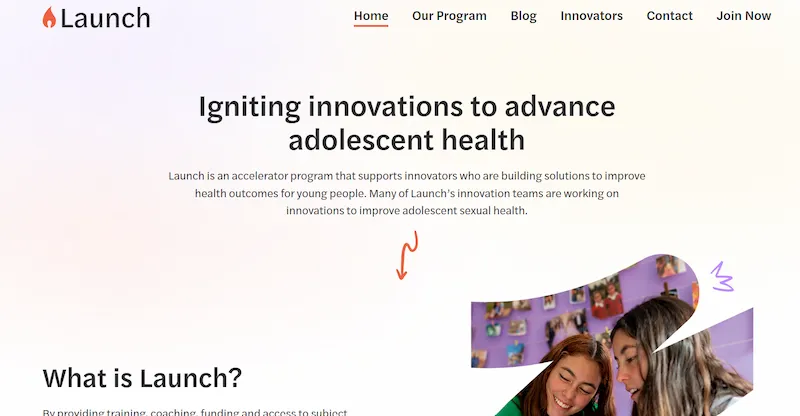
We created the Launch Innovation website for the Office of Population Affairs’ (OPA) to foster innovations in teen pregnancy prevention to help recruit applicants, facilitate the application process, market the program, and create a resource hub for future cohorts. The OPA grant gave 5 institutions macro grants to start up either incubators or accelerators to foster innovations in teen sexual health.
I was brought to lead the creation of and maintain the evaluation of the website for the OPA grant from its conception in FY24 to the end of the contract in FY27.
The primary goal of the client was for us to foster a diverse and non-traditional group of innovators through the process. My work scoping the website, facilitating co-creation sessions with stakeholders, and user informed iteration cycles, my web teams and I contributed to the continued inflow of high quality, diverse applicants to the Launch Accelerator.
Team: lead a 5-person team encompassing UX, content strategy, social media, and development.
Metrics: 13,600+ visits in first 2 years | 4x growth in applicants from 1st to 3rd cohort
The Challenge
On top of the typical challenges that come with creating a federal website, balancing multiple stakeholders, we had a 5 member coalition. managing a tight timelines, we had seven-month runway before the first cohort recruitment began. The core challenge my team was trying to define what a “non-traditional” applicant was and how to find these sorts of applicants once we defined them.
My Approach & Actions
For this, I followed the discover, co-create, iterative testing approach:
- Discovery – The team and I talked to leaders in existing non-profits in the adolescent health space to understand the right language to use and how to speak to those in this space that didn’t see themselves as entrepreneurs. We also interviewed several people who had gone through similar incubators/accelerators to what we were trying to create to identify pain points and inform user flows.
- Co-Creation – We had several organizations as part of our coalition that focused on teen sexual health. We set up regular meetings with them to co-create the look and feel of the website, the flow, and the final layout of the website. This co-creation also led us to break the application process into more steps than more traditional accelerators but make each step easier to complete and require fewer resources from people who may not have built out many of the standard things that tend to be included in an application.
- Iterative testing – To identify our target audience, the marketing lead and I created three different messages, validated by our coalition partners, tested on different platform, targeting a variety of industries/audiences during two different testing periods. Although all iterations brought traffic to the site, the largest cohort being from the Education sector with an aspirational message. We had pre-defined success as those who not only came to the site but either downloaded the application questions or clicked on the Join Now button during the application period. From the analytics, although their overall ad click through rate was one of the smallest, those in the Medical and Public Health sector were much more likely to meet our success criteria with a message around understanding your needs. This helped focus our messaging and targeting in future iterations.
Outcomes
From a point and click adventure video game for autistic youth to help them better understand relationships; To a peer-to-peer mentoring group protocol for young black men in Atlanta to “let them know they are Kings”; To a Soccer club that integrates health and sexual education for older adolescents, the methods my team and I applied influenced the future marketing, outreach, and communication strategy that led from 10 applicants in the first cohort, to just over 40 by the 3rd cohort.
